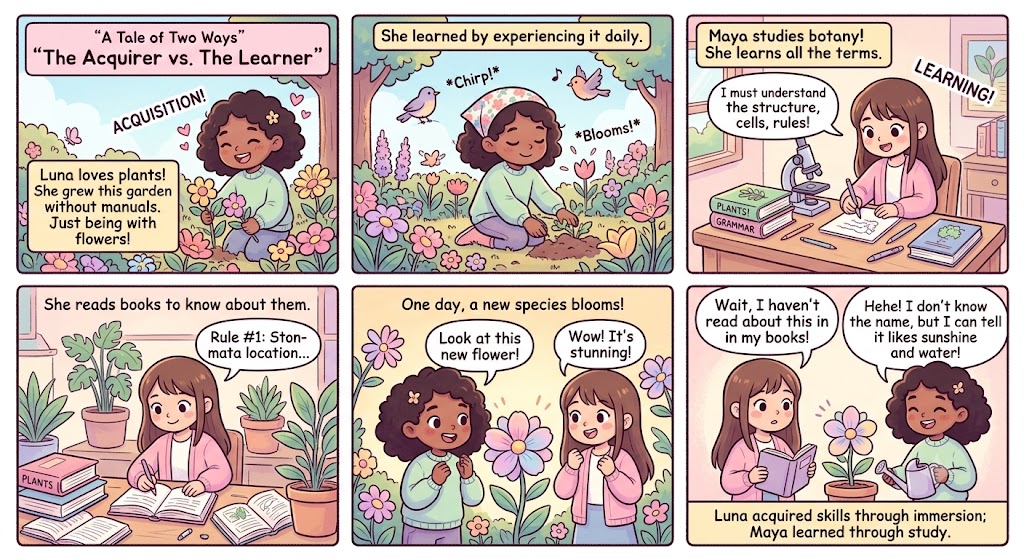
Lesson 2: Acquisition vs. Learning
The two ways we develop language ability (Krashen, 1981).
Lesson Objectives
Acquisition
Master the natural, subconscious process.
Learning
Understand the formal, conscious study of rules.
Interaction
How these systems work together in performance.
Concept Deep Dive
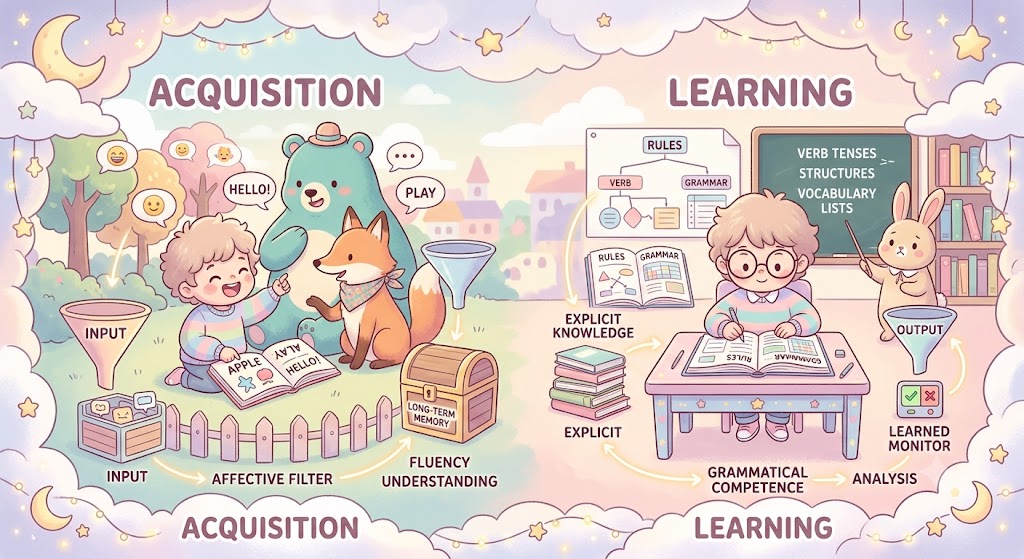
Krashen (1981) proposes that adults have two separate systems for building language ability. These systems are independent but work together:
1. The Acquired System
This is the engine of our speech. It is a subconscious process similar to how children learn their first language. When you focus on the message you are sharing, you are using this system. It is the primary source of your fluency and natural "feel" for the language.
2. The Learned System (The Monitor)
This is the conscious "editor." When we study grammar rules, we are engaging this system. According to the Monitor Model, we cannot use learned rules to create speech; we can only use them to check or "edit" the output produced by our acquired system. For the Monitor to work, three things are required:
- Time: You need enough time to think about the rules.
- Focus on Form: You must be trying to be correct, not just communicating.
- Rule Knowledge: You must actually know the specific grammar rule.
Comparison Table
| Feature | Acquisition | Learning |
|---|---|---|
| Process | Subconscious | Conscious |
| Goal | Communication | Grammar rules |
Fun Fact
Krashen argues that Acquisition is much more important than Learning for real-world fluency!
Teacher Tip
Prioritize message and meaning in your class. Save grammar rules for short, specific sessions.
Teacher's Dilemma
A student says, "I goed to the park." What should you do to prioritize Acquisition?
Practice Time
Loading...