
Lesson 3: Bloom's Taxonomy
A framework for categorizing educational goals.
Lesson Objectives
Recall
Understand the basics of organizing learning goals.
Compare
See the difference between the 1956 and 2001 models.
Apply
Learn why this taxonomy is a useful tool for teachers.
Concept Deep Dive
Bloom's Taxonomy, published in 1956, acts like a ladder for learning. It helps teachers organize goals from the simplest tasks to the most complex work, ensuring that instruction builds steadily over time.
The Original 1956 Framework
The original list used nouns to describe levels of thinking: Knowledge, Comprehension, Application, Analysis, Synthesis, and Evaluation. Knowledge was the foundation—you had to know facts before you could understand or apply them.
The Revised 2001 Framework
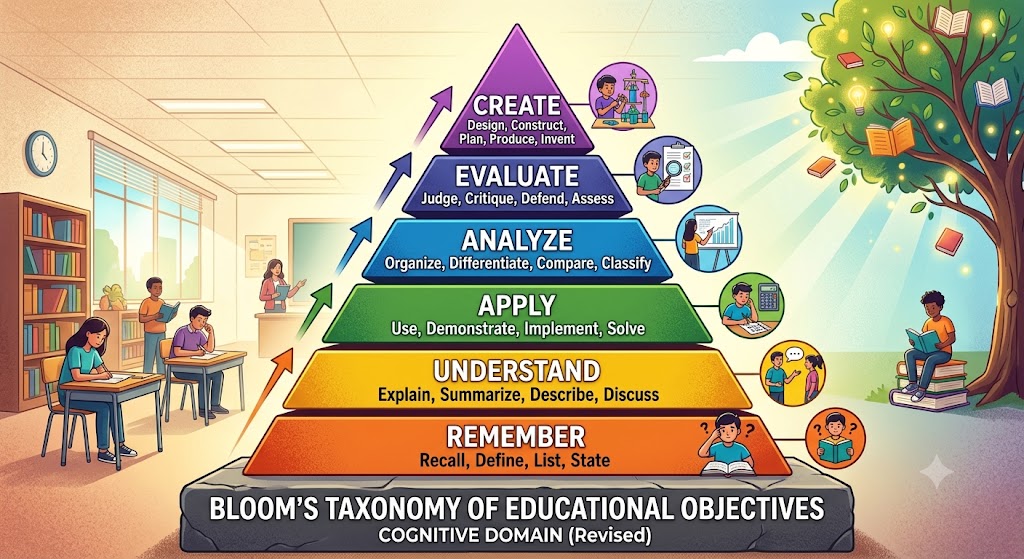
In 2001, researchers updated the taxonomy. They changed the nouns to verbs to show that learning is an active process. The levels are now: Remember, Understand, Apply, Analyze, Evaluate, and Create. "Create" replaced "Synthesis" as the highest level, emphasizing that the ultimate goal of learning is to produce new, original work.
Why It Matters for Teachers
Beyond categorizing tasks, Bloom's Taxonomy serves as a roadmap for instructional design. By using this framework, teachers can ensure that their lesson plans move students through a natural progression—starting with foundational knowledge and building toward complex critical thinking. It also helps in designing better assessments; if you only test students on 'Remembering', you won't know if they can actually 'Apply' or 'Create' using that information. This framework bridges the gap between simply transferring information and fostering deep, lasting student understanding.
Furthermore, using this framework allows teachers to align their learning objectives with their assessment methods. When a teacher knows whether they are aiming for "Remembering" or "Creating," they can design a classroom experience—and a final exam—that perfectly matches the desired level of student engagement.
Educational Model
Video Explanation
Comparison: Old vs. New
| 1956 Version (Nouns) | 2001 Version (Verbs) |
|---|---|
| Synthesis | Create |
| Evaluation | Evaluate |
| Analysis | Analyze |
| Application | Apply |
| Comprehension | Understand |
| Knowledge | Remember |
Teacher's Dilemma
A teacher gives a test that only asks students to list dates and facts. According to Bloom's Taxonomy, which level of learning is this?
Practice Time
Loading...