
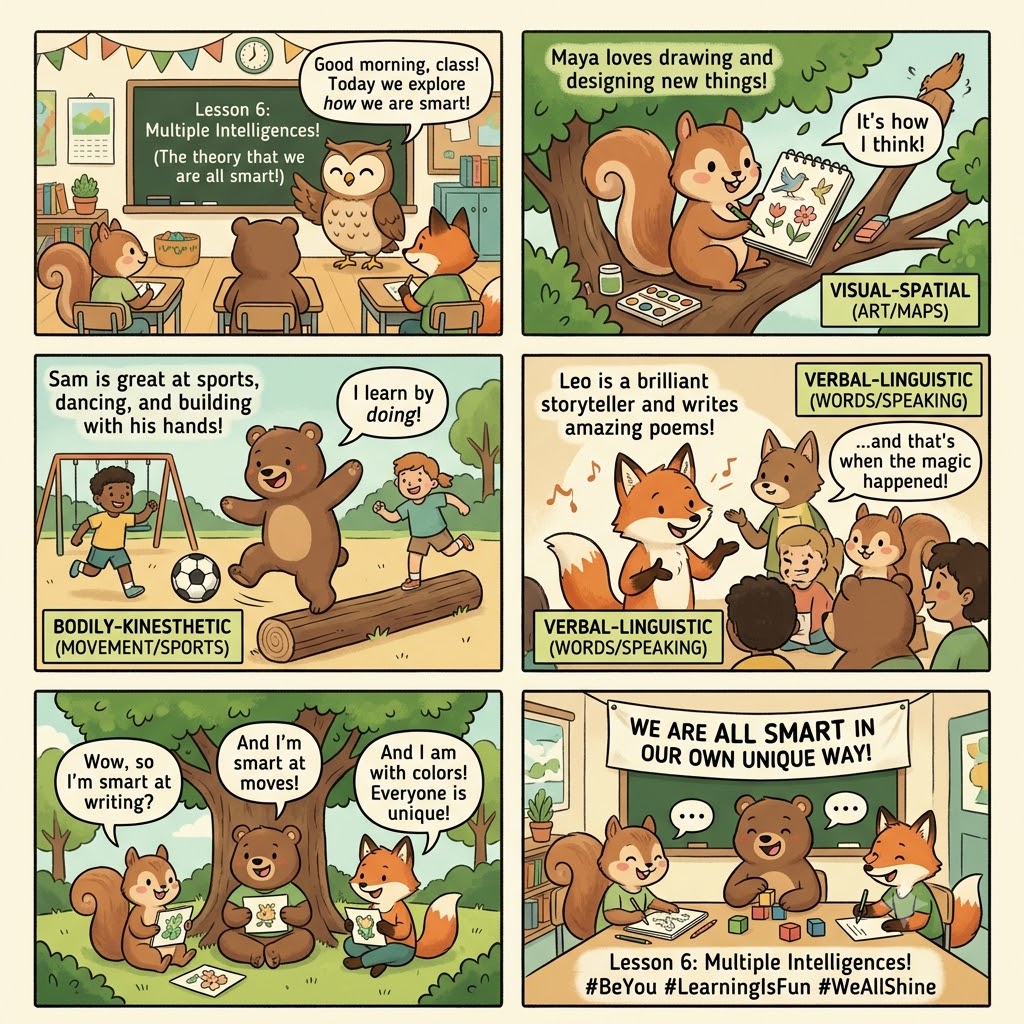
Lesson 6: Multiple Intelligences
The theory that we are all smart in our own unique ways.
Lesson Objectives
Recall
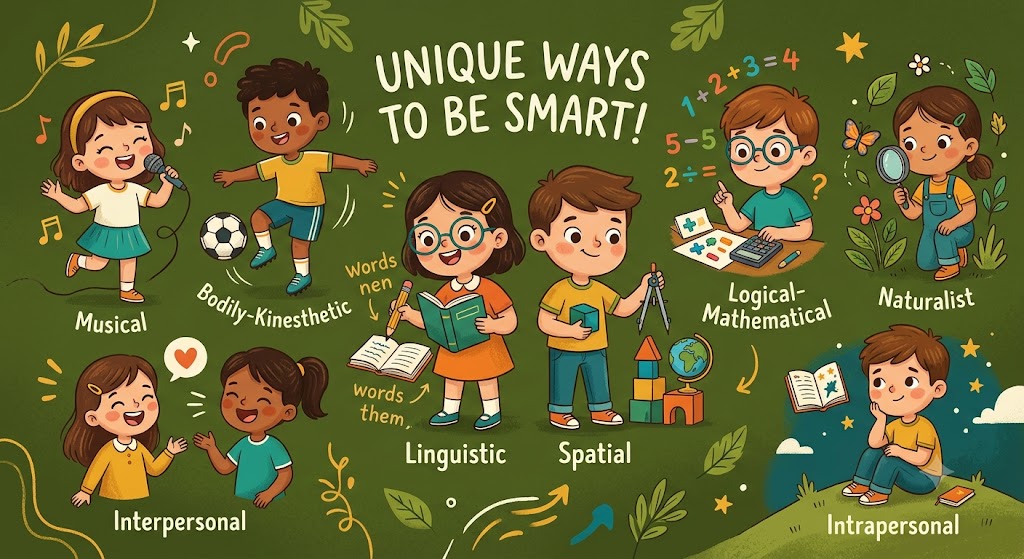
Learn the different types of intelligences proposed by Howard Gardner.
Compare
Understand the difference between traditional IQ tests and this new theory.
Apply
See how teachers can use this theory to help every student succeed.
Concept Deep Dive
In his famous book Frames of Mind, researcher Howard Gardner shared a big idea: human intelligence is not just one single thing. We are not just simply "smart" or "not smart." Instead, we have a mix of different brains and talents!
The Old Way vs. The New Way
In the past, schools only cared about two things: Math and Language. If you were good at reading and math tests (like standard IQ tests), you were called smart. But Gardner studied how the brain works and how children grow. He realized that a brilliant artist or an amazing athlete is just as "smart" as a math genius, just in a different way.
The Different Ways to Be Smart
Gardner found several different "frames of mind" or intelligences:
- Word Smart (Linguistic): Good with reading, writing, and speaking.
- Number/Logic Smart (Logical-Mathematical): Good with puzzles, numbers, and science.
- Picture Smart (Spatial): Good at drawing, reading maps, and visualizing things.
- Body Smart (Bodily-Kinesthetic): Good at sports, dancing, or building things.
- Music Smart (Musical): Good at singing, playing instruments, and hearing rhythms.
- People Smart (Interpersonal): Good at making friends, leading groups, and helping others.
- Self Smart (Intrapersonal): Good at understanding their own feelings.
- Nature Smart (Naturalist): Good at understanding plants, animals, and the outdoors.
Teacher's Dilemma
A student is having trouble with a math worksheet, but they are amazing at organizing their classmates to build a huge fort together at recess. What kind of intelligence is this student showing?
Comparison: Old vs. New
| Traditional IQ Tests | Multiple Intelligences |
|---|---|
| Focuses on one general ability. | Focuses on many different abilities. |
| Mostly tests Math and English. | Values Art, Music, Sports, and Social Skills. |
| Usually a written paper test. | Tested by doing real-world activities. |
| Says you are either smart or you aren't. | Says everyone is smart in their own way. |
Discover Your Superpower!
Click a category below to see your potential strength profile.
Practice Time
Loading...
Resources & Citations
- Gardner, H. (1983). Frames of Mind: The Theory of Multiple Intelligences. Basic Books.
- Gardner, H. (1999). Intelligence Reframed: Multiple Intelligences for the 21st Century. Basic Books.
- Armstrong, T. (2017). Multiple Intelligences in the Classroom (4th ed.). ASCD.
Keep Exploring!
Ivy Education Group ၏ အခမဲ့ Lesson များ ဖြစ်ပါသည်။
Ivy English School | Ivy Young Learner School | IELTS Ivy | Ivy Teacher Training Institute
ဆက်သွယ်ရန် ဖုန်းနံပါတ်များ:
09 751 444 167 | 09 751 444 267 | 09 751 763 490