
Task-Based Language Teaching (TBLT)
A Teacher Training Module
Lesson Objectives
What is it?
Learn exactly what Task-Based Language Teaching is and how it functions.
Why is it helpful?
Understand how the human brain naturally learns languages through problem-solving.
Real-world tasks
Discover how to use real-world tasks to replace traditional grammar drills.
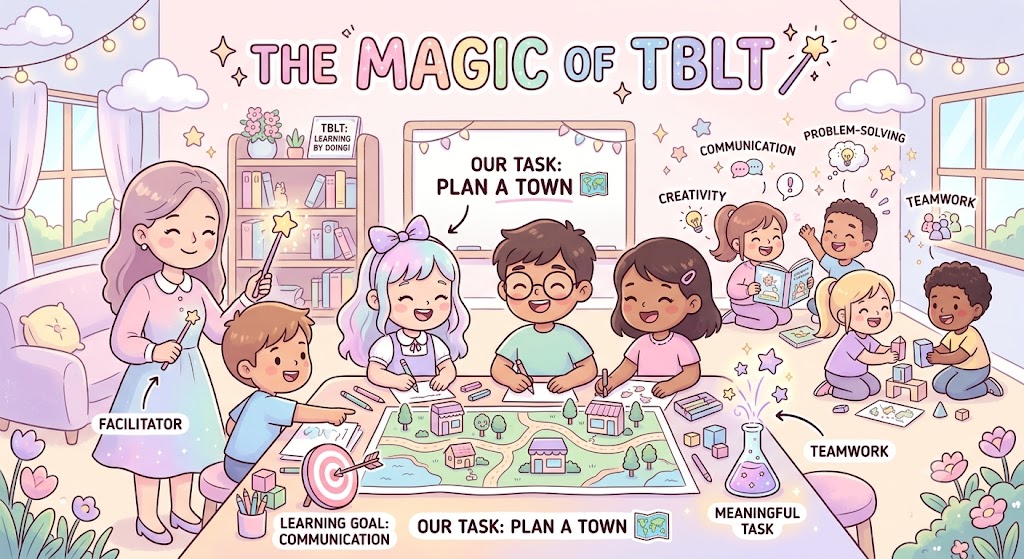
What is Task-Based Language Teaching?
Based on the book edited by Kris Van den Branden, Task-Based Language Teaching is an approach where students learn a language by actually using it to do something. Instead of just memorizing grammar rules or vocabulary lists, students are given a "task" to complete.
A task is an activity where a person tries to reach a specific goal, and they have to use language to do it. For example, painting a fence might not seem like a language task at first. But if you have to read the instructions on the paint can, or talk to your partner to decide who paints which side, it becomes a language task because you cannot finish the job without using language. Using the language becomes a means to an end.
Concept Deep Dive
In the past, many teachers used a linguistic approach. This means they chopped the language up into tiny pieces, like teaching the past tense one day and a list of food words the next day. The problem is that human brains do not learn language one tiny piece at a time. Research shows that learning is much more complex.
Task-Based Language Teaching fixes this problem by focusing on meaning first. The teacher looks at the real world and asks, "What do my students need to do with this language outside the classroom?" These are called target tasks. Examples include ordering food, reading a map, or passing a job interview.
Then, the teacher creates classroom tasks that copy or practice these real-world activities. While the students are working together to solve a problem or complete the activity, they are naturally sharing meanings, making mistakes, and learning how to communicate. The teacher is there to help them and support them, stepping in to talk about grammar or vocabulary only when it helps the students finish their task better.
Comparison Table
| Feature | Traditional Linguistic Approach | Task-Based Approach (TBLT) |
|---|---|---|
| The basic unit of a lesson | Grammar rules and single words | Functional, real-world tasks |
| Main focus for the student | Learning the form of the language | Sharing meaning and reaching a goal |
| How students are tested | Filling in blanks on a grammar test | Seeing if they can successfully complete a real task |
Fun Fact
In the 1990s, the region of Flanders in Belgium used Task-Based Language Teaching on a massive scale to help adults and children learn Dutch as a second language to combat social inequality.
Teacher Tip
Do not worry about completely ignoring grammar! TBLT still includes a focus on form, but you introduce the grammar rules naturally while the students are trying to complete a meaningful task, rather than just writing rules on the board first.
Practice Time
Loading question...
Reflective Practice
Jot down your thoughts on how you could apply TBLT in your own classroom:
References & Citations
- Van den Branden, K. (Ed.). (2006). Task-Based Language Education: From Theory to Practice. Cambridge University Press.
- Ellis, R. (2003). Task-based Language Learning and Teaching. Oxford University Press.
- Nunan, D. (2004). Task-Based Language Teaching. Cambridge University Press.
"People not only learn language in order to make functional use of it, but also by making functional use of it."
- Kris Van den Branden
Ivy Education Group ၏ အခမဲ့ Lesson များ ဖြစ်ပါသည်။
Ivy English School | Ivy Young Learner School | IELTS Ivy | Ivy Teacher Training Institute
09 751 444 167 | 09 751 444 267 | 09 751 763 490